Or how the meeting with Mirza inspired me to enter the world of his paintings
When I first saw the paintings of Mirza Čizmić, my energy exploded so much that my hair stood on end, my eyes opened, my mouth closed…
“Hey, look at me, look at me for a long time, study me, listen to me talk, play with me!”, I heard the heroes from his paintings inviting me into their madness, into a world where everything is possible, even me getting inside.
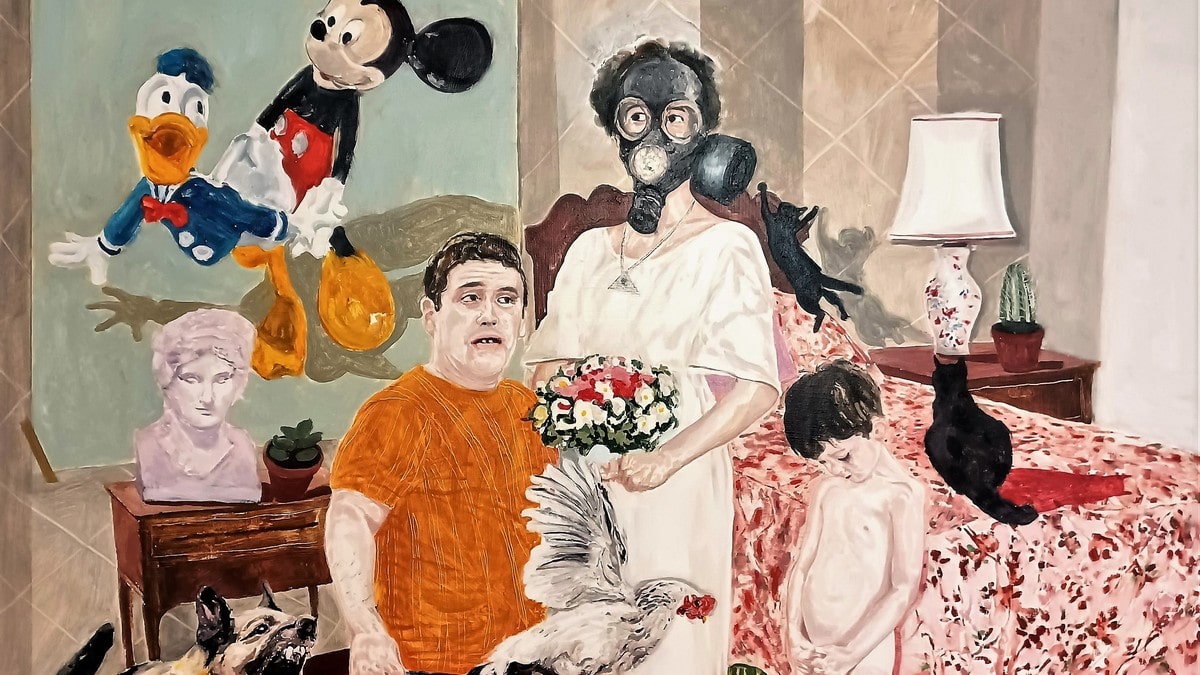
And I did enter. It was a small living room, crowded with people and furniture. At the first glance, it seemed to me that I had entered my neighbor’s apartment from the socialist skyscraper where we used to live when I was little. Carpets with patterns, heavy furniture that is never being moved, wallpaper, old fashioned TV. And not only is the furniture like a set from old Yugoslavian movies, but there are also people in costumes that we find in vintage shops as well as women with hairstyles made in stand dryers, the ones from the old hairdressing salons. The children are running around naked, a woman is cutting her child’s hair in front of a mirror in the middle of the living room, while the others are sleeping on the couch, watching TV, having lunch, playing cards, arguing. A married couple is performing, he is kneeling with his pants down while she’s spanking him as if he’s a small child and she an adult, possibly teacher.


The flow of the action in his paintings reminds me of the changing slides on a projector; I can almost hear the sound of the turning slides. Pictures are lining up, life is happening simultaneously to some people who seem like family, neighbors, friends, godfathers, ex-lovers, fresh brides in wedding dresses and older ones, equally excited.
Who are these people? Children, grandmothers, aunts, moms and dads, animals, comic book heroes. Everyone in their own microcosm, busy with their own idea.
And what I am doing with (in) them?
I can barely follow the intense plot: while mom is taking a shower, dad is sitting on the toilet, dozing with a baby in his lap. Neighbors, aunts and grandmothers are in shock looking at the young man with his underpants down, voyeur cats in the sexual trance of household members.
As I look at this omnibus, I wonder where I will end up, will I soon become a part of this family and what role will they assign me?
Or am I just a voyeur, an invisible observer in the midst of an exciting scene.
Do I see myself in the woman who put on the protective mask? Or maybe in this boy who fell asleep on the table in the middle of a heated conversation?
I remembered the scene from Haruki Murakami’s novel 1Q84 when the main character is standing on the terrace and sees himself in an apartment in a block across from his.


And then I hear from Mirza that these are all real people that he discovered in other people’s photos. He doesn’t possess a single childhood photograph of himself. But he does have stormy memories that he imprints onto faces from photographs that become hilarious characters.
You can hear the daily news at 19.30, the smell of green vegetable pie spreads from the kitchen and guests from all over come to visit us, bring us a chocolate and tire us out with stories from the crime news.
In order for a piece to have this many parallel stories, you really need to be a master.
….
Mirza’s paintings remind me of some scenes from the theater plays of Aca Popovic, Duško Kovačević and Ljuba Simović. Makavejev’s films. Music from the radio while grandma was washing the dishes and grandpa was taking an afternoon nap. Stories from colorful newspapers in hairdressing salons.
It seems to me that I cannot get around all the scenes that Mirza creates with such an ease, with a specific language full of humor and teasing, nostalgia and the awake imagination of a little boy.
…
Mirza revives his childhood and comments on it through these grotesque and ironic situations.
He works hard and likes to see progress. He talks passionately about himself and his experience. His energy is strong and charismatic. Mirza is irresistibly modest when he talks about his paintings and successes.
He explores and draws inspiration from films, books, photographs, people and destinies. I ask him if he works while he’s on vacation in Bosnia. Rest is a time for contemplation. That’s why he is full of ideas and energy to create upon returning to Helsinki.
Thank you, Mirza, for the opportunity to hear your story, how you create and what inspires you. Thank you, Banja Luka and the waterfalls on Vrbas, all of this enhanced the experience even more.

Mirza Čizmić was born in 1985 in Banja Luka. He graduated from the secondary school of applied arts in Sarajevo. He graduated from the Academy of Fine Arts in Helsinki, majoring in painting. In addition to contemporary painting, he is also involved in sculpture, performance and film. In recent years, he held several solo exhibitions and participated in numerous group exhibitions in Finland, Ireland, Sweden, Taiwan, America, Croatia.
His works are in numerous private and public collections such as Kiasma Museum of Contemporary Art, National Gallery of Finland and Hanaholmen, Swedish Cultural Center, Finland.